Sharps safety and healthcare waste management in practice
By Azmed Devices Editorial Team
Needlestick prevention depends on device design, container placement and disposal discipline working together. An educational overview for hospital safety and procurement teams.
Two layers of protection
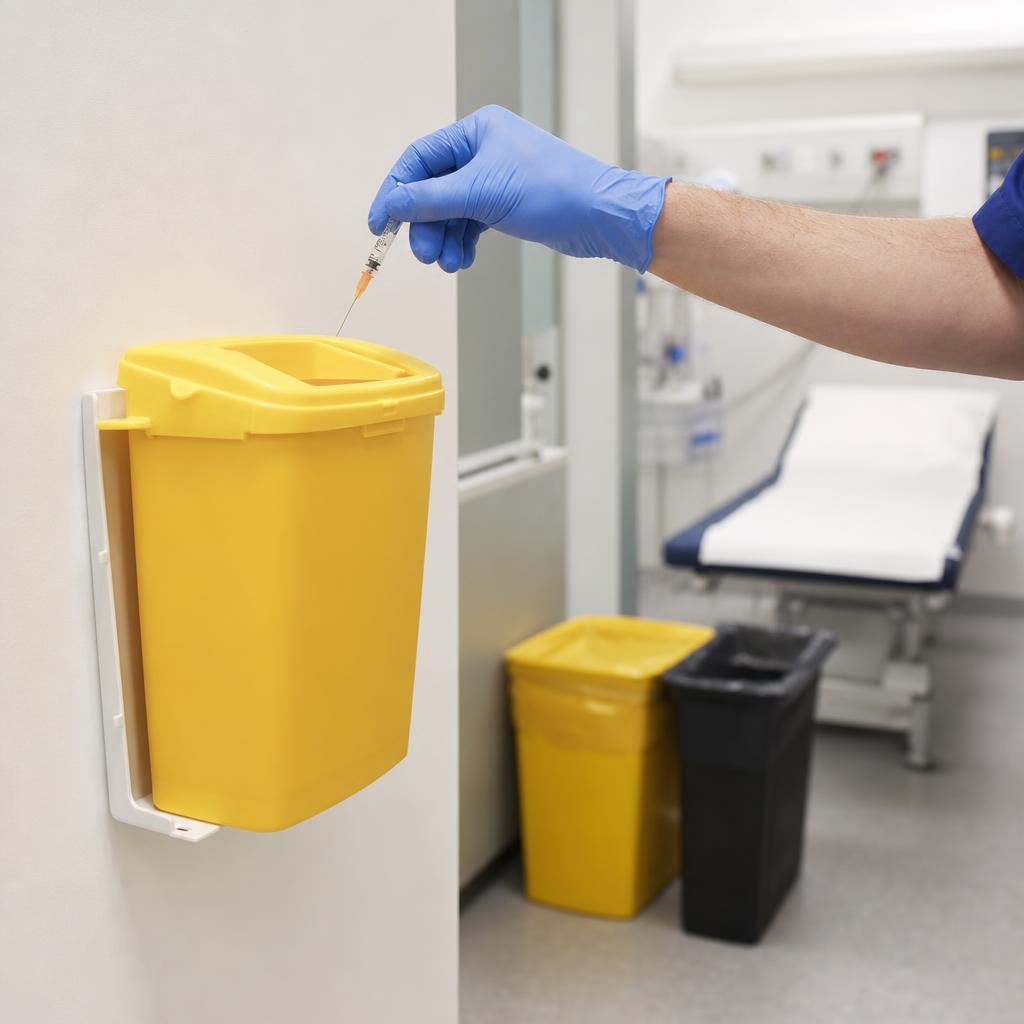
Occupational sharps injury prevention in hospitals generally rests on two complementary layers. The first is engineering controls built into the device itself, so that the sharp is shielded at the moment of withdrawal rather than left exposed on a tray. The second is the disposal pathway, so that a used sharp travels the shortest possible distance from the point of use to a closed, puncture-resistant container.
BD offers products in both layers. The company describes the BD Vacutainer Eclipse blood collection needle as a safety-engineered device with a shield that allows one-handed activation to cover the needle immediately upon withdrawal from the vein, with an audible click confirming activation. BD also lists shielded peripheral IV catheter families, including the BD Insyte Autoguard shielded IV catheter, within its vascular access portfolio.
Containers and point-of-use placement
BD publishes a dedicated sharps disposal product family covering BD sharps containers. On that page, BD signposts public guidance from the U.S. Food and Drug Administration on the best way to get rid of used needles and other sharps, and on safely using sharps at home, at work and while travelling, which reflects the general principle that container selection and disposal behaviour are regulated and guidance-driven rather than left to individual judgement.
In practice, container programmes are decided by three variables: volume and fill-line discipline, mounting position relative to where procedures actually happen, and the replacement cycle. Containers placed too far from the bedside encourage transport of exposed sharps; containers overfilled past the fill line create the exact hazard they were meant to remove. Both are audit points that hospital infection-control committees typically review on a fixed schedule.
Building the programme around policy
Sharps safety is ultimately a policy question supported by products. A working programme usually specifies which safety-engineered devices are standard for each procedure, who is authorised to disable or bypass a safety feature and under what circumstances, how injuries are reported and followed up, how waste streams are segregated, and how staff are trained and retrained on activation technique. Recording near-misses is often as informative as recording injuries.
Local healthcare waste regulations govern segregation, storage, transport and final treatment, and hospital policy must follow those requirements. Detailed specifications and available configurations are available on request. Azmed Devices provides documentation, tender support and supply coordination for BD technologies in Azerbaijan.
Source
Manufacturer statements in this article are drawn from BD's official website. See https://www.bd.com/en-us/products-and-solutions/products/product-families/bd-sharps-disposal and https://www.bd.com/en-us/products-and-solutions/products/product-families/bd-vacutainer-eclipse-blood-collection-needle. This article is general educational content and is not clinical or regulatory guidance; product availability in Azerbaijan is subject to local registration.